
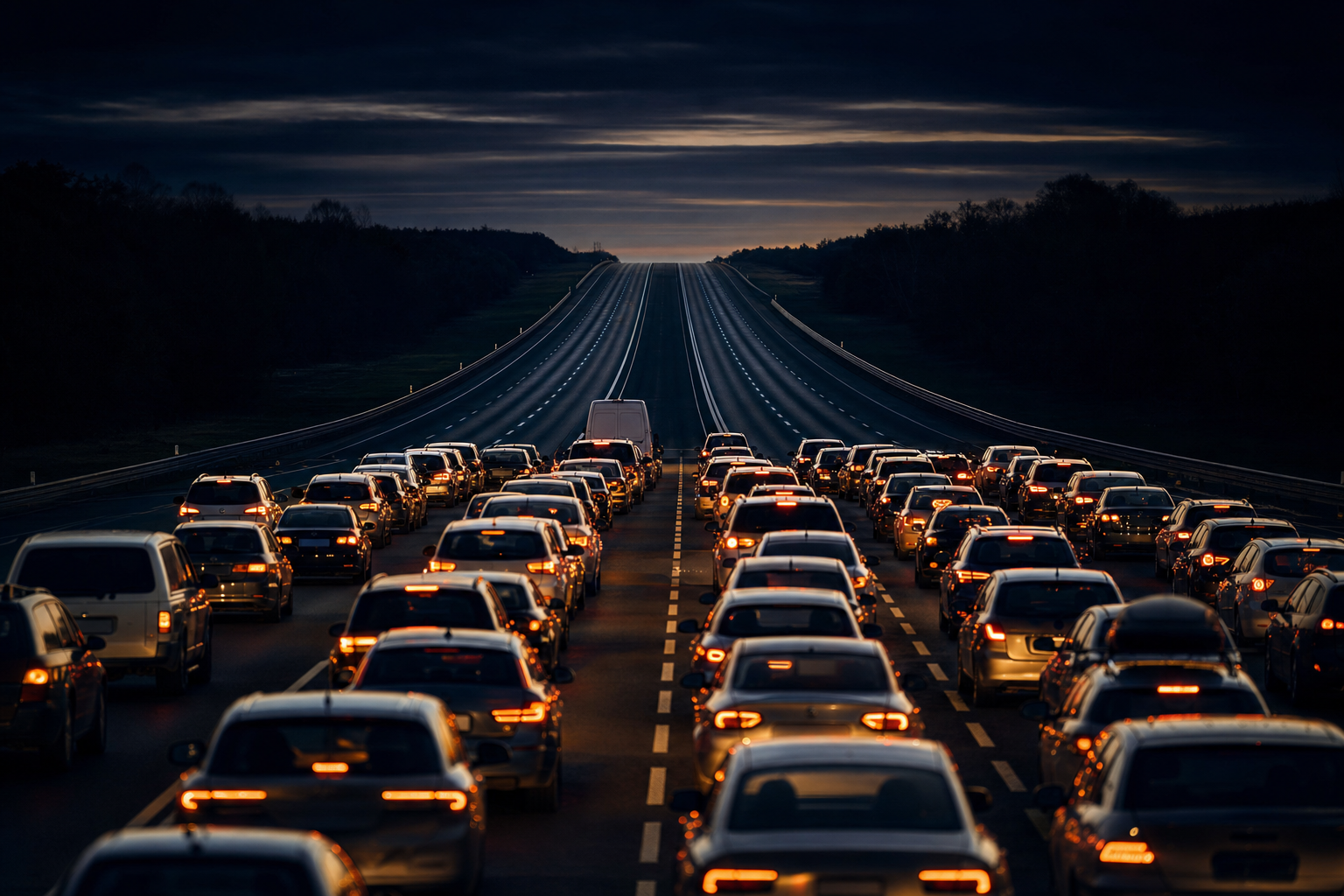
Eight cars on a road. Same year, same make, same model. A human driver at the front, and behind him seven cars running adaptive cruise control, each holding the gap its manufacturer designed it to hold.
The lead driver slowed by six miles an hour. The sort of adjustment you make without noticing you have made it.
By the time that reached the last car in the line, it was a twenty-five mile an hour event. The system in that car gave up and handed the wheel back to its driver.
Nobody made a mistake. Every car in that line was doing exactly what it was built to do.
The test
That was the validation run for a study published in the IEEE Transactions on Intelligent Transportation Systems. Seven 2018 model vehicles, two manufacturers, more than twelve hundred miles of driving. The question in the title was whether the cruise control you can actually buy smooths traffic out.
The answer in the paper is one word. No.
Every system tested amplified the disturbance instead of absorbing it. Nine commercial systems have now been through this. Nine of nine.
Why anyone expected otherwise
The expectation ran the other way, and reasonably so. A machine reacts in milliseconds where a person needs about a second, so a road full of machines ought to be smoother than a road full of us. Two decades of traffic simulations said exactly that.
Then researchers at the European Commission’s Joint Research Centre put a five car platoon on a public road and measured the response instead of assuming it. About one and one tenth of a second.
Which is a human reaction time. The reflex the models had been granting these systems was never in the hardware.
What the lag actually does
Being slow is not the problem. Concentrating is.
The JRC drivers described it from inside the following car. The controller reacted late, and then braked harder than the moment ever called for, because by the time it moved it had less room to work with. Their note records that this never happened when a person was driving. The person had already started easing off.
A driver reads the brake lights three cars ahead through the windscreen of the car in front. A radar sees one bumper. You cannot read the whole road from inside the car, and the machine is further inside it than you are.
Then the traffic moves again, and the second half arrives. The same measurements show the gap opening out past three seconds during the recovery before the system closes it back down. Prompt on the brake, slow on the throttle.
That asymmetry is not a fault. Braking is a safety event, so it is firm. Accelerating is a comfort event, so it is gentle. Every incentive in the design points at the one behaviour that destabilises the line.
Pool every experiment worldwide, seventeen models across eight manufacturers, and the disturbance travels backwards down the queue at close to a hundred kilometres an hour. In human traffic it moves at about nineteen.
The machines did not calm the wave. They fired it backwards four or five times faster.
Now inspect one car
Take any single vehicle out of that line and examine it. Correct following distance. Correct reaction. Measurably safer, one at a time, than the driver it replaced. You would find nothing wrong with it, because there was nothing wrong with it.
The line still jammed.
The defect was not at any station. It was in the handover between them.
Your business has spent two years getting better at stations
Better tools at each desk. Faster software. Automation at the points that were obviously slow. Most of those decisions were correct on their own terms, and most of them were measurable, and you can point at the improvement each one delivered.
And you are moving more slowly than you were.
That is not a contradiction. Flow is not set by how good the stations are. It is set at the narrowest point, and making everything either side of a narrow section faster does not widen it. It delivers work to the queue sooner, which feels like progress right up until you look at the queue.
Which is also why the slowness shows up where it does. It shows at the front, in leads and pricing and the website, because the front is the part you can see. So you look there, hard and honestly, and you find nothing broken. The lane is open.
The cause is behind you. In traffic it always is, and that is precisely why you cannot find it when you finally reach the front.
What fixed the cars, and what did not
Better reflexes did not. They already had those, and it made things worse.
What works is the cars telling each other what they are about to do, so the whole line receives the signal at the same moment and there is nothing left to travel backwards. Researchers measured that version too, and it is stable.
It is also not in the cars you can buy.
Cooperation, not reflex. The fix belongs in the handover, because that is where the defect was born.
The question this leaves you with
It is narrower and less comfortable than what should I do.
Where is my narrowest section, and what is it costing me a month?
If you can answer that from data, rather than from a hunch or a benchmark or what your accountant thinks, then you do not need anything from me and you never did. Go and widen it.
If you cannot answer it, then the money you spend before you can is going somewhere upstream of the problem, at full price, into a lane that was never the constraint. That is not a reason to panic and it is nothing to decide today. It is a reason to stop guessing, which costs nothing and which you could start this afternoon.
The Business Tree Diagnostic takes three minutes and asks for no email address.
There is a short book behind it, Phantom Jam, forty-eight pages and nine dollars. The diagnostic is useful without it.
Juan Jeffery Healthy Wealthy Investor
General business information only. Not personal financial, tax, legal, credit or investment advice, and nothing here is a recommendation to buy, sell or restructure anything.
Leave a Reply